
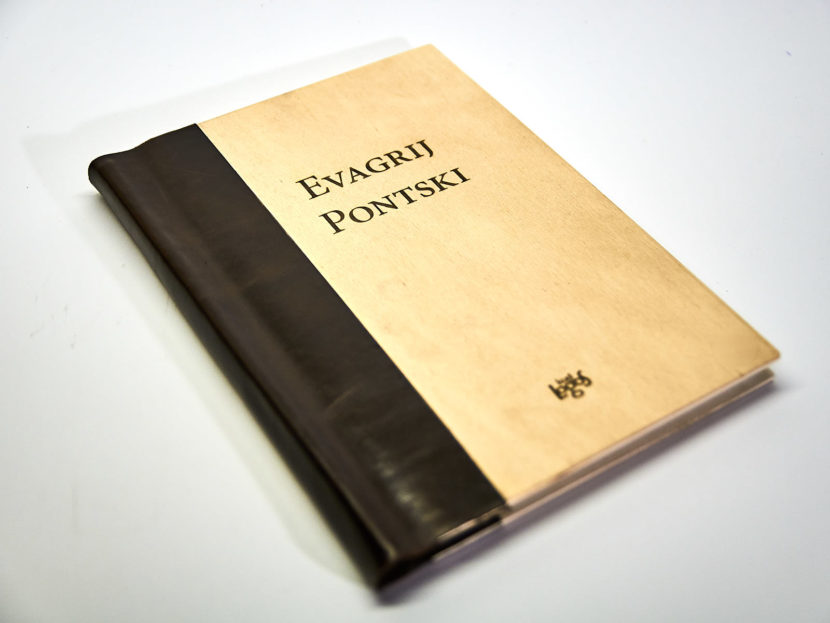
Some projects do not emerge as standard design assignments, but as direct responses to a specific request within tight time and production constraints.
In this case, I was commissioned to produce a unique book with wooden covers, and due to the timeframe, I also printed and bound the book block myself.
Such work requires more than aesthetic decisions. It demands a clear understanding of how materials behave together as a system.
The book as a physical system
The book block was hand-sewn and glued at the spine, ensuring structural stability and long-term durability.
The connection between the book block and the covers was achieved through reinforced endpapers, which act as a mechanical interface between the rigid and flexible components of the construction.
This is not simply a technical solution, but a critical design decision that determines how the object behaves physically over time.
Material as meaning and structure
The front and back covers are made from poplar wood, laser-engraved on the front surface.
Here, wood is not used as decoration, but as a structural and expressive material that defines the character of the entire object.
Combined with a leather spine, the result is a deliberate contrast between rigidity and flexibility—two material behaviours that directly shape how the object is handled and experienced.
Details that define use
In physical objects, small additions often have a disproportionate impact on the final experience.
In this case, a custom fabric pocket was added to protect and complement the book as a gift object, secured with a blue ribbon.
Such elements are not purely functional; they influence how the object is presented, stored, and ultimately perceived.
Design as physical consequence
In projects like this, design cannot be separated from execution.
Every decision—material selection, binding method, reinforcement strategy, and finishing detail—directly affects durability, tactile experience, and meaning.
Design in this context becomes the management of physical consequences.
Conclusion
The wooden book in this case was not only a craft object, but an exploration of the relationship between material, construction, and use.
It demonstrates that design does not exist only in communication systems or digital interfaces, but also in physical reality, where decisions become permanent and tangible.