
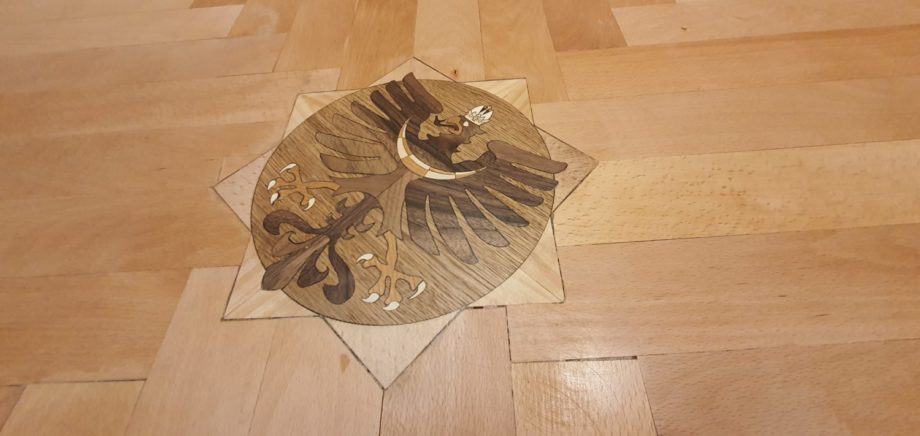
Visual elements within parquet flooring can play an important role in defining space, as they function not only as decoration, but as a way of shaping orientation, hierarchy, and the character of an architectural environment. They can also carry references to location or historical context embedded within the space itself. On this basis, the following two inlay elements were designed.
Design within spatial constraints
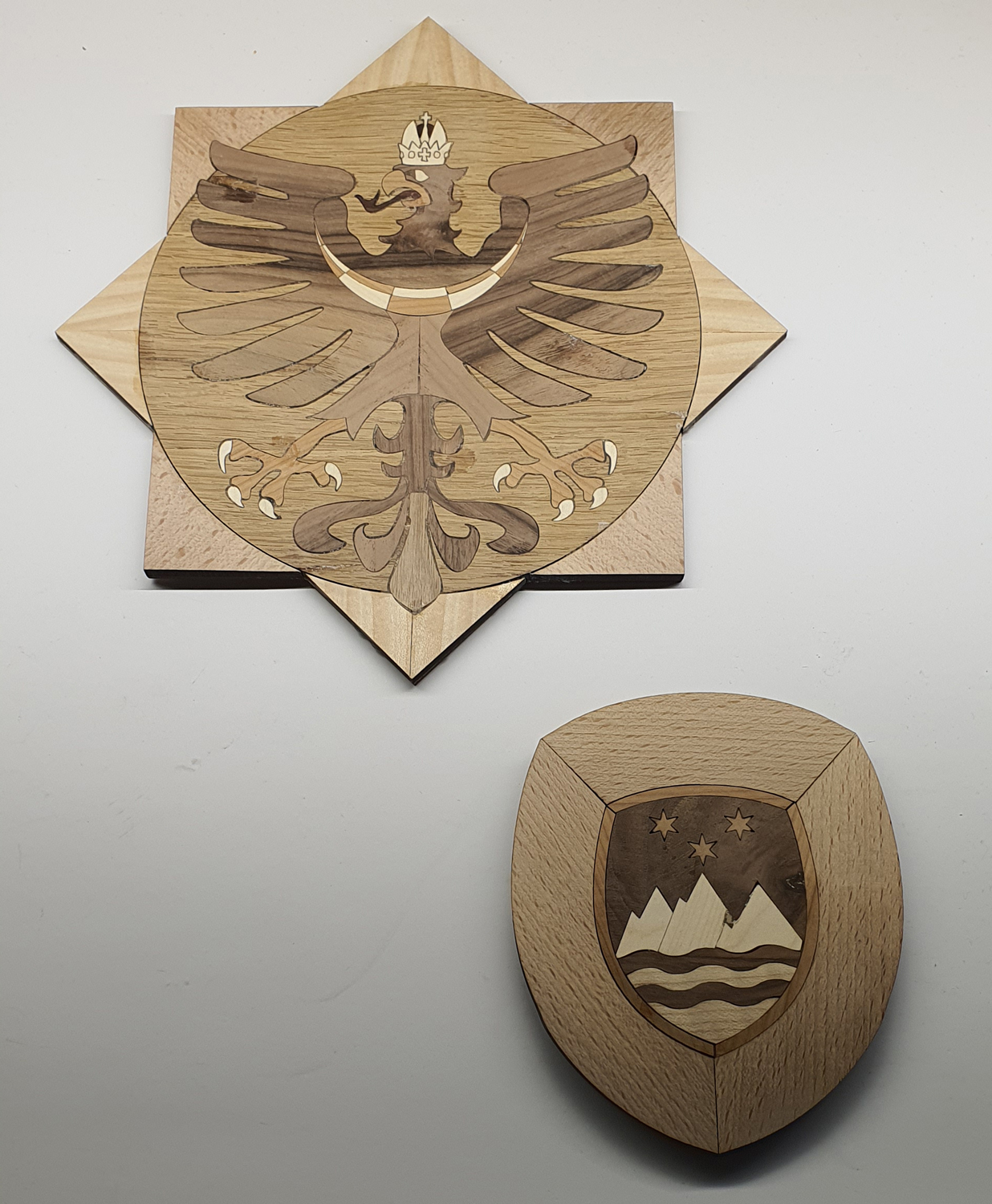
The upper medallion features a custom interpretation of the eagle from the historical coat of arms of Carniola, a region that once covered most of present-day Slovenia.
The lower medallion represents the coat of arms of Slovenia.
In both cases, the challenge was not only visual composition, but also translating symbolic imagery into a material system suitable for precise fabrication and long-term physical use.
Material structure as visual hierarchy
Both medallions are constructed from multiple hardwood species, each chosen for its tonal and textural properties rather than purely aesthetic variation.
Different woods were assigned to different visual layers of the composition, allowing contrast, depth, and clarity at a distance as well as in close view.
The inlays are mounted onto a beech plywood base, which provides structural stability and ensures compatibility with the surrounding flooring system.
Integration into the built environment
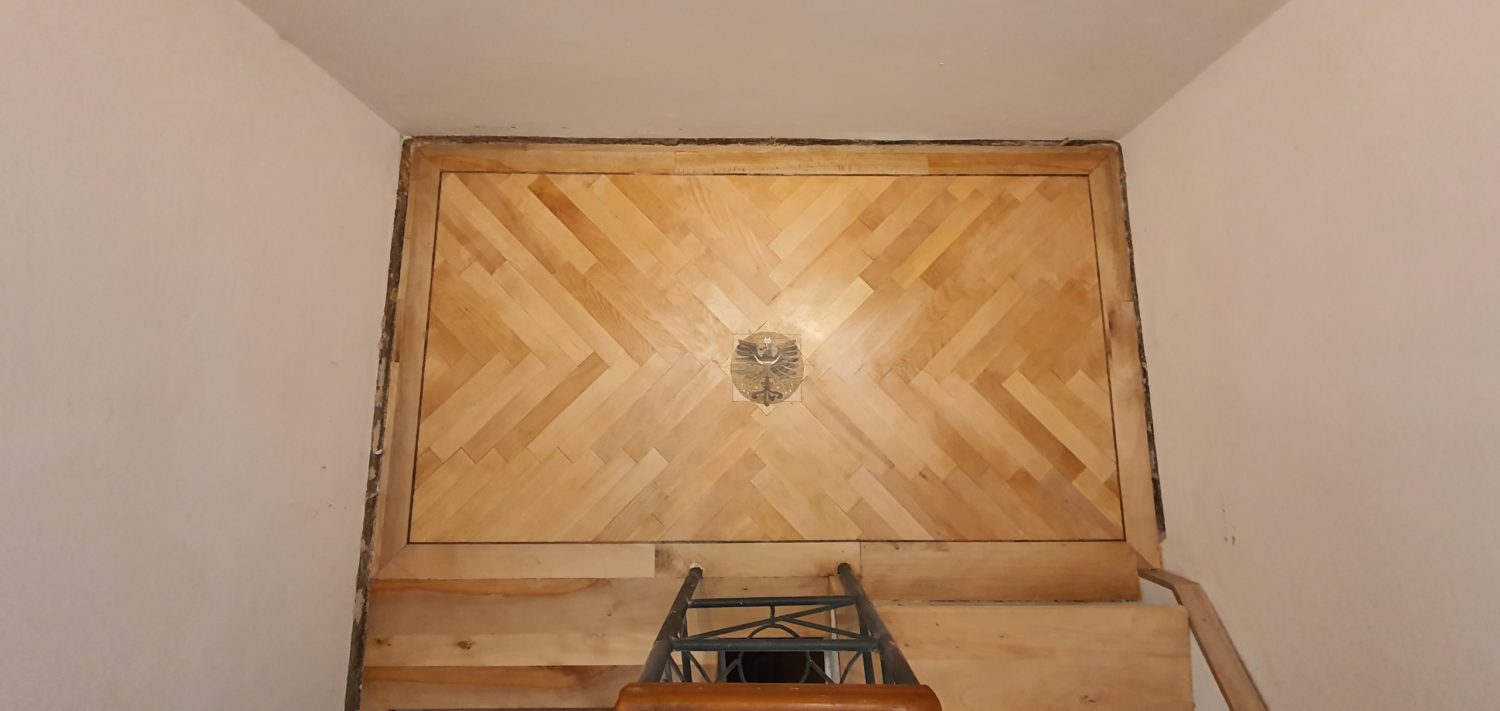
The upper medallion was designed specifically for integration into a beech parquet staircase landing.
The flooring system itself follows a clear structural logic:
a central inlaid element is separated from the surrounding planks by a walnut border strip, creating a controlled visual framing device within the floor layout.
This transforms the inlay from an isolated object into part of a larger spatial composition.
Design as embedded decision-making
In projects like this, design is not only about visual form, but about how that form behaves once embedded into an environment.
Material choice, structural layering, and composition all determine how the object will age, be maintained, and perceived within daily use.
The result is a design intervention that operates at the scale of both detail and space.