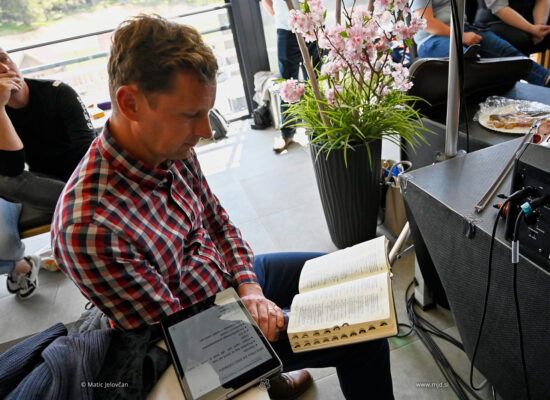

Over the past year, I worked on the design and development of several updated editions of the Slovene Bible for the Bible Society of Slovenia.
These projects were not individual redesigns in isolation. They formed part of a broader system of related publications, each serving different users and reading contexts while still belonging to the same family of editions.
Each format required its own set of decisions, constraints, and priorities.
Designing for different needs within one system
Instead of applying a single solution across all editions, the work was structured around distinct publication types, each with a specific purpose.
1. Study Bible edition


The Study Bible had not been updated for many years.
The aim of the redesign was twofold:
to preserve its scholarly character while improving readability and physical usability.
Updates included:
- new cover designs
- lighter physical construction
- updated endpapers in the luxury edition
- revised maps in hardcover versions
The key question here was not “how should it look new”, but rather how to improve usability without weakening its authority as a study resource.
2. Hardcover and luxury edition (without apocrypha)


This edition also required renewal after a long period without significant changes.
Improvements included:
- redesigned cover
- updated endpapers in the luxury edition
- ribbon bookmark integration
- addition of reading plans with checkboxes
The focus here was less on visual change and more on supporting long-term engagement with the text.
3. Pocket editions with zipper


The pocket editions serve a different context entirely: mobility, practicality, and frequent use.
This series expanded an existing concept with updated colour and material combinations, designed to reach a broader audience while remaining consistent with the existing product family.
Additional refinements included updated endpapers and bookmarks.
A shared underlying question
Despite differences in format and audience, all editions were guided by the same question:
How do you maintain recognition of a long-standing publication while improving how it is used in practice?
In this context, design is not a single intervention but a coordinated system of decisions that must remain coherent over time.